
Why AI can't plan your trip
AI has been talked about a lot lately as it relates to vegan travel planning. And travel planning in general.
"Can't I just use ChatGPT to plan my vegan trip?"
"I'm just going to ask Claude."
"Gemini is going to plan my trip for me!"
And look, I get it.
AI can't plan your trip

You open an app, type in your destination and dates, and a full itinerary appears in seconds. It has hotel names, restaurant recommendations, day-by-day plans. A very nicely laid out itinerary.
It looks like someone did the work for you.
Finally, the research is starting to catch up with what I've been saying for a while now.
AI can get you started. It cannot deliver you a full plan and a stress-free and worry-free trip.
Especially if you're vegan.
There's way too much at play that AI is going to miss for you to have a smooth vegan travel experience.
What AI does well
First, let's remember that the data centers and cloud increase greenhouse gas emissions, consume a ton of energy, deplete our water and require a lot of natural resources).
The reality is, AI is everywhere now and avoiding it is nearly impossible.
That being said, I know people use AI, and want to address that reality.
AI tools are good at structure.
They can lay out a logical route across a city or a country, suggest a reasonable order for sightseeing, and produce a skeleton itinerary faster than any human can.
If you want to brainstorm destinations, get a rough sense of what a place offers, or map out a trip framework, AI can be useful.
A 2026 study by InsureMyTrip put this to the test.
Researchers gave three AI tools the same prompt:
Plan a luxury seven-day trip across Switzerland for four adults, two of them age 60 or older.
Every tool produced a well-organized, readable itinerary with logical routes. Travelers had something tangible.
However, upon closer examination, what AI produced wasn't going to deliver an accurate trip.
Where AI travel loses the plot

The InsureMyTrip researchers looked at each itinerary for accuracy, pricing, pacing, and logistics. What they found lines up with what travel industry experts have been tracking for the past two years.
For example, information about restaurants and hotels were not accurate.
Several recommendations didn't exist as described, or carried ratings that couldn't be verified. When you build your day around dining -- especially as a vegan -- and it turns out to be wrong, hangry isn't going to cut it. And, neither is having to settle for some fries.
In addition, it found that pricing doesn't reflect reality.
AI-generated estimates for luxury experiences were frequently lower than actual costs. For four travelers in premium transport and accommodations, even a modest gap per line item becomes a significant problem by the end of the trip.
And, it didn't plan the trip according to real life pacing. The Switzerland itineraries regularly stacked walking-heavy days back to back and included high-altitude excursions without any health or fatigue considerations for older travelers.
AI doesn't know your group. It doesn't build in recovery time. It doesn't know that two of your travel companions can't do back-to-back mountain hikes.
The best part?
True to form, it delivered the wrong information confidently.
Fabricated or inaccurate information comes out of AI tools in the same tone as accurate information. AI leaves out that it might not have the right information, or that it improvised, or worse, hallucinated and just made up information to plan your trip.
And, you'd never know.
There's no flag, no asterisk, no "I'm not sure about this one."
Speaking of AI hallucination, researchers from Travel and Tour World have been tracking that. Hallucinations included invented hotel names, incorrect transit schedules, inaccurate visa requirements, fictional towns on weather maps.
The system doesn't know what it doesn't know ... but it's not going to let you in on that information.
The InsureMyTrip study put it plainly: use AI itineraries as drafts, not final plans, before booking anything nonrefundable.
Why vegan travelers are more exposed
For a general traveler, an AI hallucination might mean a restaurant recommendation that turns out to be mediocre. That's annoying. It's not devastating.
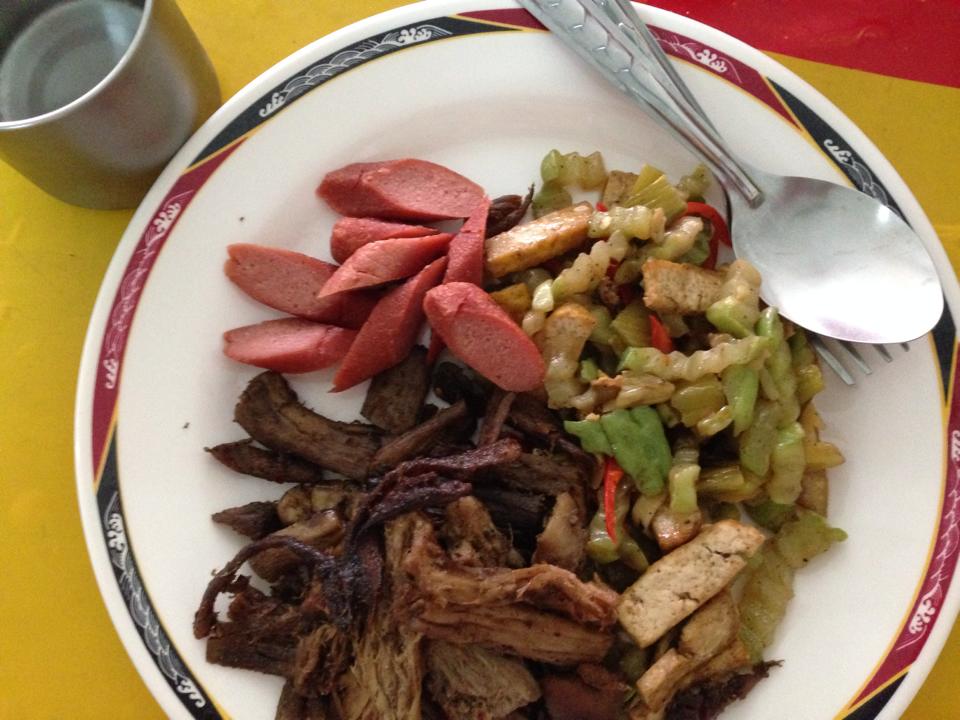
But, for a vegan traveler, the same hallucination can mean showing up to a restaurant that doesn't exist, or one that has no vegan options, or one where you find out too late that the restaurant may have been marked as vegan-friendly somewhere in the online universe, but actually they can't accommodate to vegans because they use fish broth in all of their veggie dishes.
In some destinations, finding a backup isn't as simple as walking a block.
AI tools do not vet menus. They do not have the ability call ahead. Or know the nuances of vegan menus and what to look for, and they certainly can't ask.
They also can't tell you which Four Seasons properties have vegan menus that will blow your mind, or which incredible Michelin restaurants can cater to a vegan diet, even though it isn't promoted.
AI also cannot assess the ethical dimensions that matter. It won't flag that a lodge that calls itself sustainable is greenwashing its conservation claims, or that a wildlife experience is not what it appears to be. To vet at all, there's got to be knowledge, and ability to know what questions to ask and some research beyond the basics.
When the stakes include your values and a significant amount of money, a confident-sounding itinerary with information that isn't right is a sure fire way to ruin your investment.
What to do instead of using AI

AI can help you brainstorm destinations, explore what a city or region offers, and think through a rough structure for your time. But, a real, live human can do so much more.
All the information needs to be verified from the restaurants to menus to hotels to ethical activities to logistics.
For vegan travelers specifically, that verification has to be thorough so it acutally aligns with what you care about.
That verification process is the time and effort that goes into travel planning. AI skips it.
But, investing in a vegan travel advisor to do it on your behalf all happens before your trip even takes place.
The bottom line
It comes as no surprise that 66 percent of Americans have now used AI to plan at least part of a trip. But, AI isn't able to deliver you a finished product that will result in an amazing trip that matches how you want to feel and aligns your ethics with the experience.
If you want someone to do that research for you, apply today for custom vegan itinerary planning.